



Pyrrolobenzodiazepines
Pyrrolobenzodiazepines (PBDs) are sequence-selective DNA minor-groove binding agents that covalently attach to guanine bases and create durable DNA damage[1]. Mechanistically, PBD dimers form non-distorting interstrand cross-links, while SJG-136 reacts with guanine bases in the 5′-GATC-3′ sequence and shows higher cytotoxicity than melphalan in CHO repair models[2][3]. In cancer research, PBDs have progressed from natural products to synthetic monomers, hybrids, dimers, and antibody-drug conjugate (ADC) payloads[1][4]. Compared with related DNA-binding systems, PBD activity differs from duocarmycin or CC-1065 analogs that alkylate adenine-rich minor-groove sites, and PBDs show insignificant affinity for most DNA G-quadruplexes without large C8 substituents[5][6]. For experimental applications, linker length and guanine spacing shape PBD dimer adduct patterns, supporting rational design of sequence-selective DNA cross-linking agents and ADC payloads[7][8].
References:
- [1]. Mantaj J, et al. From Anthramycin to Pyrrolobenzodiazepine (PBD)-Containing Antibody-Drug Conjugates (ADCs). Angew Chem Int Ed Engl. 2017 Jan 9;56(2):462-488. [Content Brief]
- [2]. Hartley JA. The development of pyrrolobenzodiazepines as antitumour agents. Expert Opin Investig Drugs. 2011 Jun;20(6):733-44. doi: 10.1517/13543784.2011.573477. Epub 2011 Apr 4. PMID: 21457108. et al. The development of pyrrolobenzodiazepines as antitumour agents. Expert Opin Investig Drugs. 2011 Jun;20(6):733-44. [Content Brief]
- [3]. Clingen PH, et al. The XPF-ERCC1 endonuclease and homologous recombination contribute to the repair of minor groove DNA interstrand crosslinks in mammalian cells produced by the pyrrolo[2,1-c][1,4]benzodiazepine dimer SJG-136. Nucleic Acids Res. 2005 Jun 8;33(10):3283-91. [Content Brief]
- [4]. Tiberghien AC, et al. Comparison of Pyrrolobenzodiazepine Dimer Bis-imine versus Mono-imine: DNA Interstrand Cross-linking, Cytotoxicity, Antibody-Drug Conjugate Efficacy and Toxicity. Mol Cancer Ther. 2023 Feb 1;22(2):254-263. [Content Brief]
- [5]. Boger DL, et al. CC-1065 and the duocarmycins: unraveling the keys to a new class of naturally derived DNA alkylating agents. Proc Natl Acad Sci U S A. 1995 Apr 25;92(9):3642-9. [Content Brief]
- [6]. Rahman KM, et al. Pyrrolobenzodiazepines (PBDs) do not bind to DNA G-quadruplexes. PLoS One. 2014 Aug 18;9(8):e105021. [Content Brief]
- [7]. Rahman KM, et al. Effect of base sequence on the DNA cross-linking properties of pyrrolobenzodiazepine (PBD) dimers. Nucleic Acids Res. 2011 Jul;39(13):5800-12. [Content Brief]
- [8]. Procopiou G, et al. DNA sequence-selective G-A cross-linking ADC payloads for use in solid tumour therapies. Commun Biol. 2022 Jul 29;5(1):741. [Content Brief]
-
Pyrrolobenzodiazepines Related Products (8)
Related Products (8)

-
SG3199
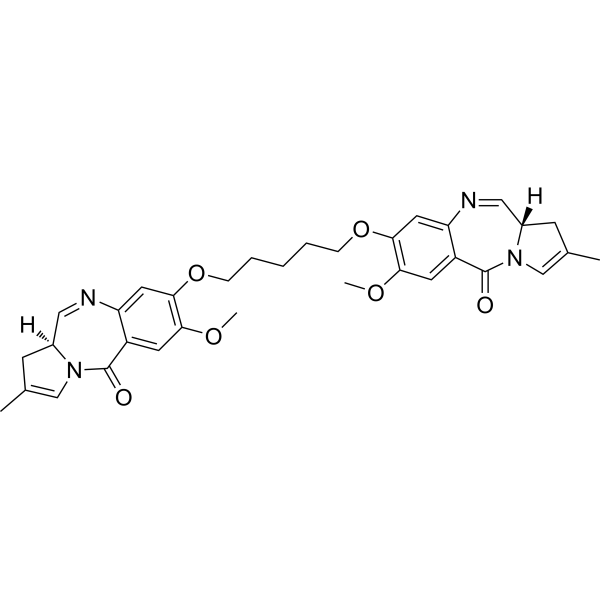 0 ImagesSG3199 is a cytotoxic DNA minor groove interstrand crosslinking pyrrolobenzodiazepine (PBD) dimer. SG3199 is the released warhead component of the ADC payload Tesirine (SG3249).
-
SJG-136
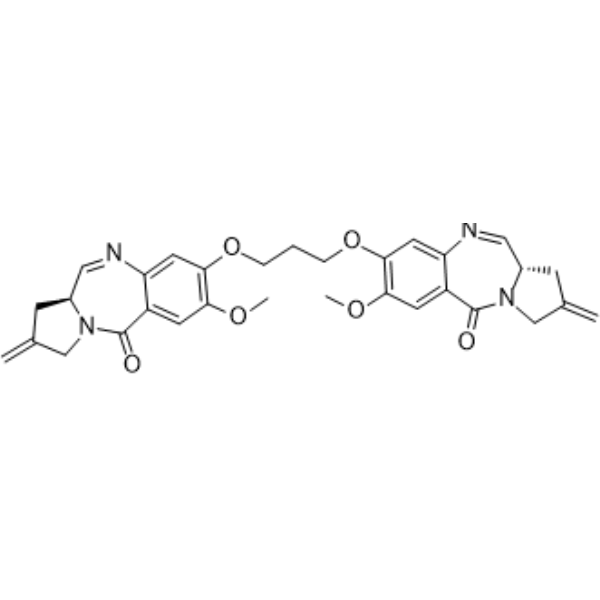 0 ImagesSynonyms: NSC-694501SJG-136 is a DNA cross-linking agent, with an XL50 of 45 nM for pBR322 DNA. SJG-136 has potent antitumor activity.
-
SG2057
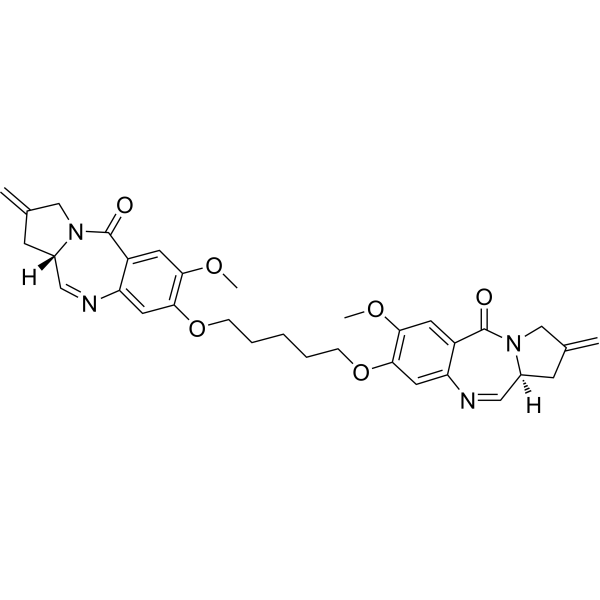 0 ImagesSynonyms: DRG16SG2057 (DRG16) is a PBD dimer containing a pentyldioxy linkage which binds sequence selectively in the minor groove of DNA forming DNA interstrand and intrastrand cross-linked adducts. SG2057 is a highly active antitumor agent.
-
Hemiasterlin
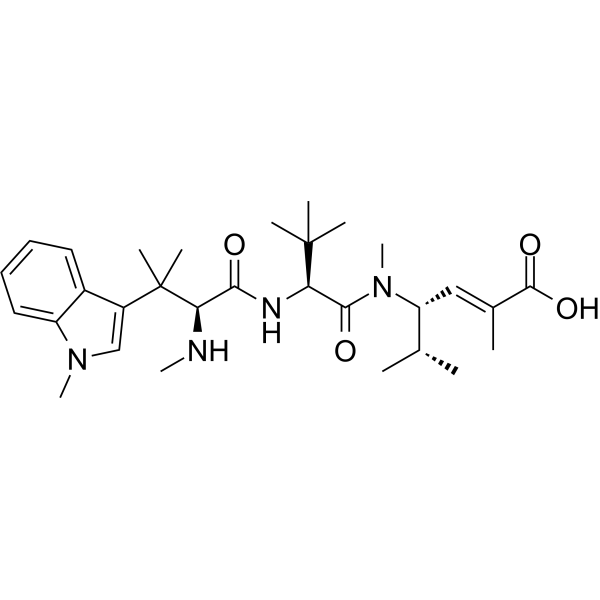 0 ImagesSynonyms: (-)-Hemiasterlin; Milnamide BHemiasterlin ((-)-Hemiasterlin) is an antimitotic marine natural product with potent anticancer effects. Hemiasterlin can be used as a cytotoxic payload (ADC Cytotoxin) in antibody-drug conjugates (ADCs).
-
Tomaymycin DM
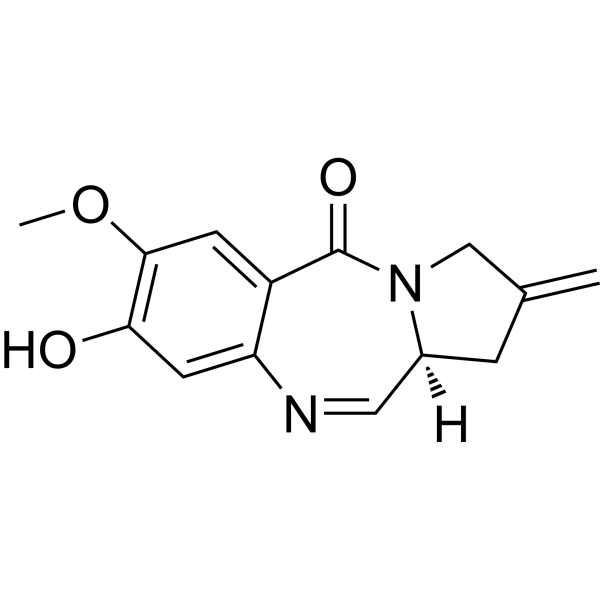 0 ImagesCat. No.: HY-102001CAS No.: 945490-09-5Tomaymycin DM is a derivative of Tomaymycin (HY-N10174) that belongs to the class of DNA alkylation inhibitors and acts as an effective payload for ADCs. Tomaymycin stabilizes the double-stranded DNA structure, inhibits various DNA processing enzymes, blocks transcription, and ultimately induces DNA strand breaks and apoptosis. Tomaymycin DM can be used in studies related to the development of ADCs targeting multiple cancers including leukemia and ovarian cancer.
-
Aniline-MPB-amino-C3-PBD
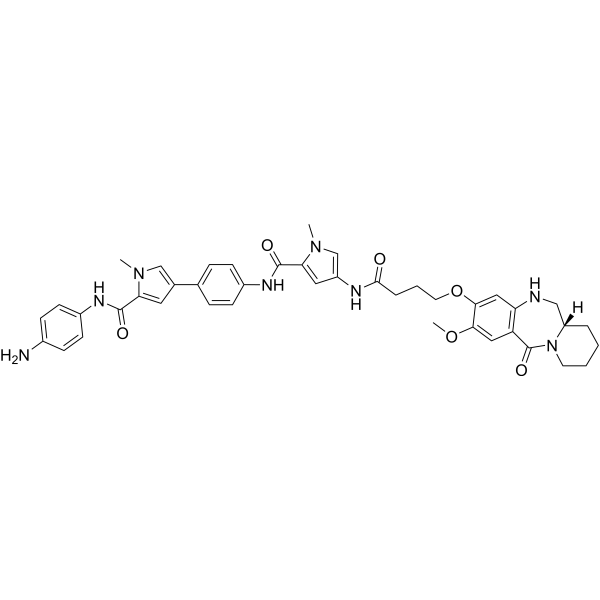 0 ImagesCat. No.: HY-135900CAS No.: 2412923-79-4Aniline-MPB-amino-C3-PBD is a cytotoxic agent comprised non-alkylating group. Aniline-MPB-amino-C3-PBD is a sequence-selective DNA minor-groove binding agent. Aniline-MPB-amino-C3-PBD acts as the payload for ADCs. Antimicrobial activity.
-
Py-MPB-amino-C3-PBD
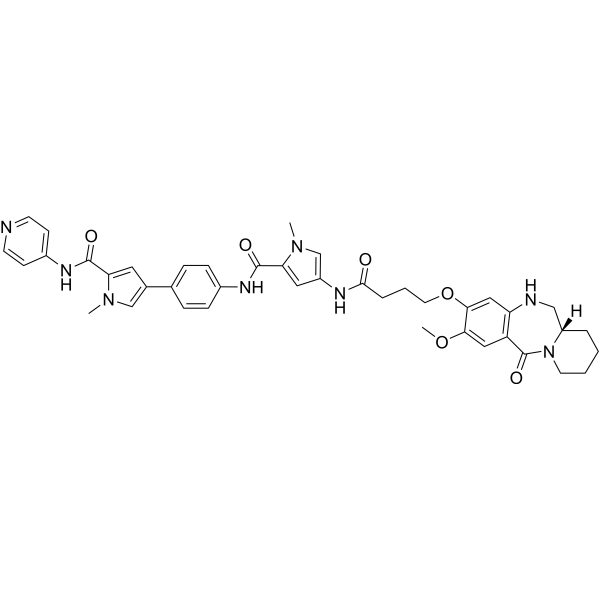 0 ImagesCat. No.: HY-135901CAS No.: 2412924-07-1Py-MPB-amino-C3-PBD is a cytotoxic agent comprised non-alkylating group. Py-MPB-amino-C3-PBD acts as the payload for ADCs. Antimicrobial activity.
-
Dimethyl-SGD-1882
 0 ImagesCat. No.: HY-126678CAS No.: 3026416-27-0Synonyms: Dimethyl-PBD dimerDimethyl-SGD-1882 (Dimethyl-PBD dimer) is a highly potent DNA alkylator, and is used as an antibody-drug conjugate (ADC) cytotoxin. PBD Dimer is a DNA alkylator which inhibits DNA replication.



